
Could Better-Functioning Soil Become Part of Flood Resilience?
Flood resilience normally focuses on what happens once water begins accumulating:
drains, pipes, culverts, detention systems, streams, rivers and stopbanks.
All are important.
But before much of that water reaches conventional infrastructure, something else has already happened.
The rain has landed on the landscape.
At that point, the physical condition of the ground begins influencing what happens next.
Water can enter the soil.
It can occupy available pore space.
It can move deeper or laterally through the profile.
It can be retained and later used by vegetation.
Or it can remain at the surface and begin moving downhill as runoff.
That creates an important opportunity:
What if we could improve the way suitable areas of existing managed soil receive, store and move rainfall before that water becomes a downstream problem?
DCT believes there is a scientifically credible reason to investigate exactly that.
The Proposition at a Glance
ESTABLISHED
Soil structure, compaction, pore architecture and roots influence how water enters, moves through and leaves soil.
OBSERVED UNDER DCT PROGRAMMES
Historical commercial monitoring has recorded measurable changes in soil structure and rooting, including average recorded root depth moving from approximately 62 mm to 105 mm across ten monitored paddocks.
NOT YET ESTABLISHED
Whether DCT treatment changes runoff volume, runoff timing or peak flow by a meaningful amount.
THE OPPORTUNITY
If a useful hydraulic effect can be independently demonstrated and repeated across large areas of existing managed land, better-functioning soil could become another distributed layer of flood resilience.
The Science Starts Beneath the Surface
Soil is not simply solid material beneath vegetation.
It has an internal architecture.
Sand, silt, clay, mineral particles, organic material and biological components become organised into larger structural units called aggregates.
Between and within those aggregates is a network of pores.
That pore network strongly influences how air and water behave below ground.
A systematic review examining 153 published studies found significant relationships between soil structure and water infiltration, including relationships between structural characteristics and hydraulic conductivity.
The implication is fundamental:
How soil is put together can influence how rainfall moves into and through it.
And soil structure is not permanent.
It can be damaged.
It can become compacted.
It can lose pore continuity.
But it can also develop.
That is where the opportunity begins.
Why Compaction Changes the Equation
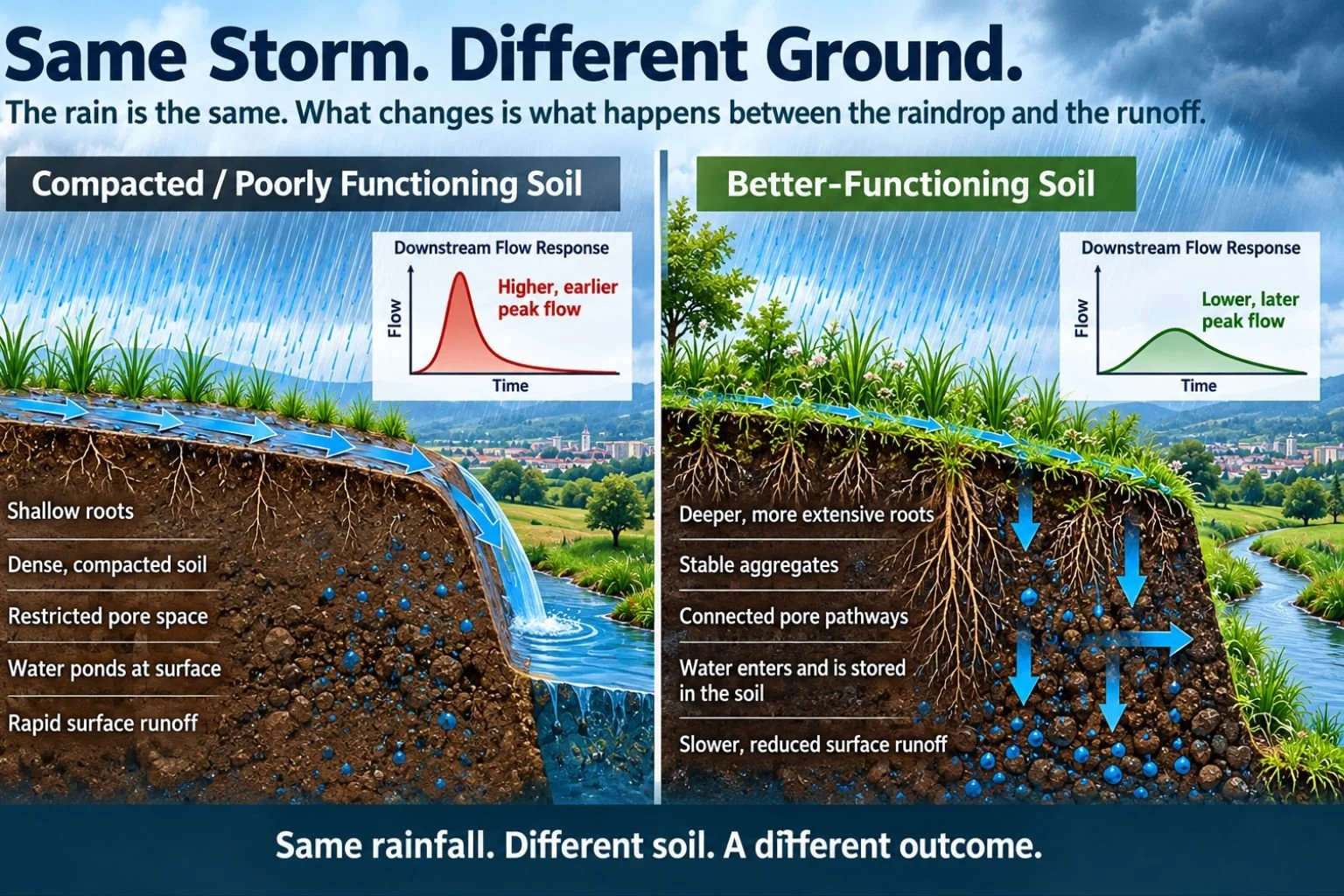
Two areas can both look green from above while behaving very differently during a storm.
One may contain stable aggregates, connected pore pathways and extensive roots.
Another may have been compressed by machinery, livestock, construction or repeated traffic.
Compaction can rearrange soil particles and aggregates, increase density and reduce or disconnect important pore pathways.
That can influence how rapidly water enters the soil and how readily it can move once below the surface.
If rainfall arrives faster than the soil–land system can accept or accommodate it, more water becomes available for ponding and surface runoff.
Research examining soil compaction and flooding has found that plot- and hillslope-scale experiments generally show increased runoff from compacted soils.
At whole-catchment scale the relationship becomes more complex because rainfall, topography, soil type, saturation and the proportion of affected land all matter.
But the underlying physical mechanism is clear:
When the soil's ability to receive and transmit rainfall is restricted, more water can become available for rapid surface runoff.
New Zealand Is Already Seeing This Beneath Its Cities
This is not simply an agricultural issue.
Recent Auckland investigations found that some areas mapped as permeable were behaving very differently in practice.
Earthworks and development had compacted soils beneath apparently green areas to the point that, during larger storms, some were behaving hydrologically more like impervious surfaces.
The conclusion from that work is particularly important:
Soils should be treated as part of our infrastructure.
A park, verge or green space may look permeable from above.
But appearance does not determine hydraulic performance.
The soil underneath has to function.
Current New Zealand work has also reported modelling showing that protecting and restoring soil function can reduce runoff volumes and peak flood flows.
That changes how we can think about resilience.
Instead of seeing soil simply as the material surrounding infrastructure, we can ask:
What contribution could the soil itself make?
From Raindrop to Runoff
The mechanism is not one single process.
It is a connected system.
Rain reaches the surface
The soil has to be capable of accepting water.
Structure creates an organised soil environment
Stable aggregates help maintain the spaces between soil particles.
Pores provide pathways and storage
Different pore sizes contribute differently to rapid transmission, temporary storage and water retention.
Roots interact with that structure
Roots explore the profile, influence aggregation and pore development, remove water between rainfall events and can leave pathways behind as roots turn over.
Water enters and redistributes
Rainfall can infiltrate, occupy available storage, move vertically or laterally, or become available to vegetation.
Water the system cannot accommodate contributes to runoff
That water begins moving toward lower ground, drains, streams and rivers.
The important point is not that functioning soil can absorb an unlimited storm.
It cannot.
The important point is:
Soil condition influences how rainfall is partitioned and how quickly part of that rainfall becomes surface runoff.
We Already Know Soil and Vegetation Can Change Stormwater Behaviour
This broader principle is not theoretical.
A 2025 global meta-analysis examined 50 field-monitored urban bioretention systems.
Across those purpose-built assets, average:
Runoff-volume reduction: 63%
Peak-flow reduction: 74%
These systems were specifically engineered to receive and manage stormwater.
They are not evidence of what DCT treatment will achieve on existing land.
But they demonstrate something extremely important:
When the hydraulic functioning of a soil–vegetation system is deliberately changed, both the amount and timing of runoff can change materially.
DCT's question is different.
Rather than constructing a new stormwater asset everywhere:
Could we improve the functioning of soil that is already there?
That is the opportunity we want to test.
But How Could DCT Influence That System?
This is where the DCT mechanism becomes more specific.
DCT's approach uses a proprietary combination of functional organic fractions and other soil- and plant-functional compounds, delivered in liquid form.
The objective is not simply to put material on the surface.
It is to introduce functional fractions into an already active soil–water–mineral–root system.
First: The Treatment Enters the Soil Environment
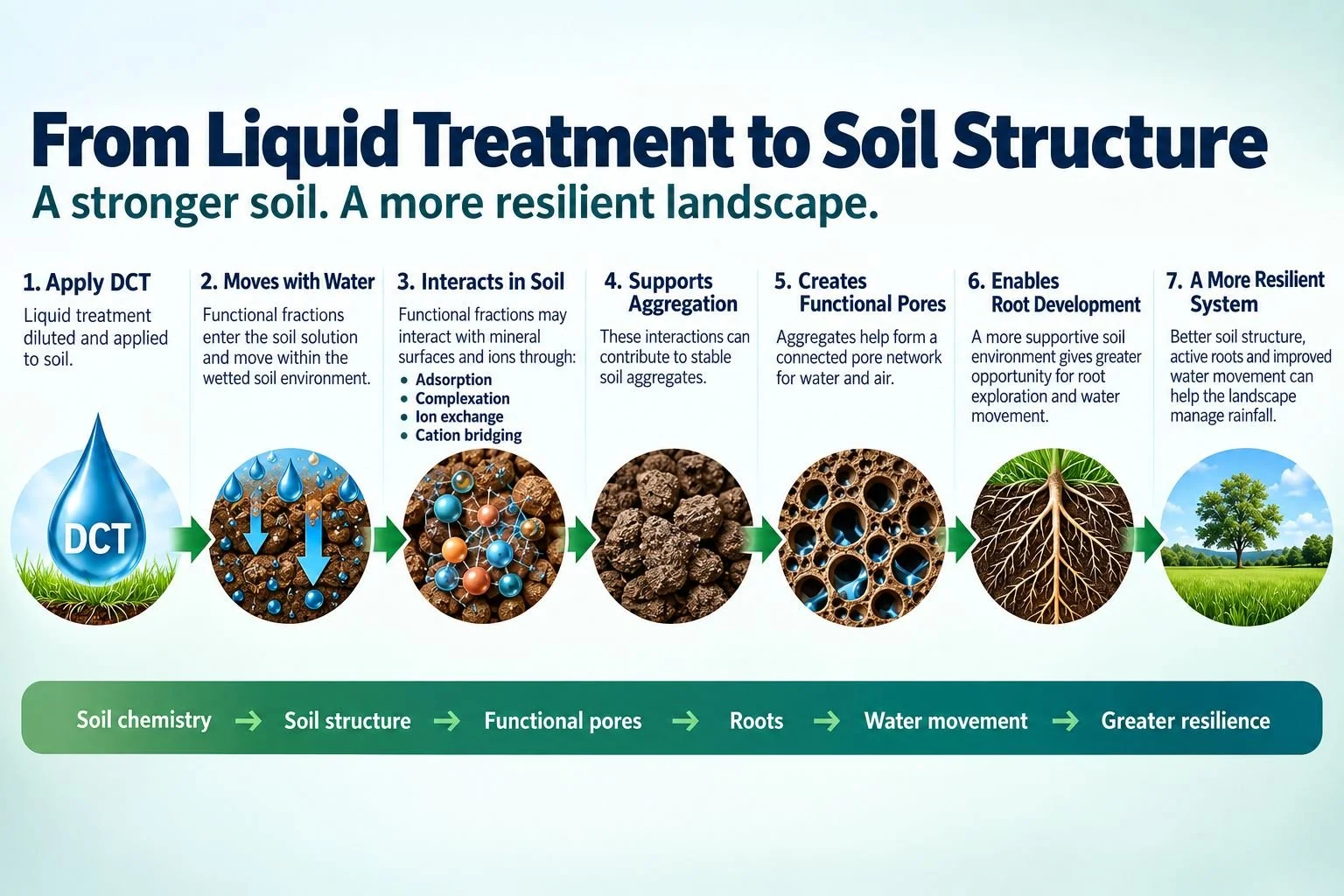
Following dilution and application, soluble functional fractions can enter the soil solution and move within the wetted soil environment.
The soil solution is the thin, chemically active water phase surrounding particles, aggregates and roots.
Within it, dissolved ions, mineral surfaces, organic compounds, root exudates and biological processes continually interact.
Different functional fractions can behave differently according to characteristics such as molecular size, solubility and chemical functional groups.
The soil receiving them matters too.
Mineralogy matters.
pH matters.
Ionic conditions matter.
Water movement matters.
DCT therefore does not propose one universal reaction occurring identically in every soil.
The important principle is:
The treatment enters an existing chemically active soil system rather than acting independently of it.
How DCT's Functional Fractions May Interact With Soil Colloids and Mineral Surfaces
Some of the smallest mineral and organic particles in soil are colloidal in size.
Clay minerals and other reactive mineral surfaces can carry electrical charges and provide sites where ions and organic compounds interact.
Depending on their properties and the surrounding soil chemistry, functional organic fractions may participate in recognised soil processes including:
Adsorption
Association of compounds with mineral surfaces.
Complexation
Interactions between functional groups and dissolved ions.
Ion exchange
Movement of ions between charged surfaces and the surrounding soil solution.
Cation bridging
Situations where positively charged ions help connect negatively charged organic and mineral surfaces.
Modern soil science shows that these mineral–organic interactions are dynamic rather than governed by one simple reaction.
The balance between them varies with mineralogy, pH, ionic strength, moisture, competing ions and the organic compounds involved.
So DCT does not claim that every one of these pathways has been measured in the finished DCT treatment.
Their importance is that they explain the recognised chemical environment into which DCT's functional organic fractions are being introduced.
This is the scale at which the chemistry underlying soil structural development begins.
From Colloids to Aggregates
Individual soil particles do not create functional structure simply by existing beside one another.
They need to become organised.
Soil aggregation can involve interactions between mineral particles, organic compounds, roots, microorganisms and ions.
Some positively charged ions can help bridge negatively charged mineral and organic surfaces.
Organic materials can associate with mineral surfaces.
Root- and microorganism-derived compounds can contribute additional binding and stabilising processes.
Together, these physical, chemical and biological interactions can contribute to the formation and stability of soil aggregates.
And aggregates matter for a reason:
They help create the physical architecture through which water moves.
From Aggregates to Pores
When soil particles become organised into stable aggregates, spaces remain between and within them.
Those spaces form part of the soil pore network.
Different pores do different jobs.
Larger, connected pores can provide relatively rapid pathways for excess water and air.
Smaller pores can retain water more strongly.
Root channels, earthworm channels and structural cracks can provide further pathways.
So the target isn't simply:
more pores
or
softer soil.
The more useful objective is:
Functional pore architecture.
A soil capable of receiving water, temporarily accommodating it, transmitting excess water and still retaining water in useful parts of the profile.
Then Roots Become Part of the Architecture
Roots are not passive occupants of soil.
They can physically change it.
Growing roots explore existing pores and create new pathways.
Root exudates interact with mineral and biological processes in the rhizosphere—the highly active zone surrounding living roots.
Vegetation also withdraws water from the soil between rainfall events.
As roots die and are replaced, some root channels can remain as pathways through the profile.
Scientific reviews show that roots can significantly alter soil hydraulic properties.
But the direction and magnitude of the effect depend on soil type, root diameter, root density and environmental conditions.
So the relationship is not:
deeper roots = guaranteed higher infiltration.
It is more sophisticated:
Root development is one component of the physical system controlling soil structure, pore connectivity, storage and water movement over time.
A Potential Reinforcing System
Several processes can therefore begin connecting.
A more supportive soil environment
↓
greater opportunity for root exploration
↓
greater interaction between roots, minerals, organic compounds and biology
↓
further development of aggregation and pore pathways
↓
better opportunity for air and water movement
↓
conditions capable of supporting further root development
This is not automatic.
Nor will it occur identically in every soil.
But it explains why DCT's approach focuses on the soil–root system, rather than treating poor structure, compaction, restricted rooting and poor water movement as unrelated problems.
This Is Where the Flooding Hypothesis Becomes Interesting
Put the proposed pathway together:
DCT treatment
↓
functional organic fractions enter the soil environment
↓
potential interactions with mineral surfaces, charged sites, ions and the root-zone environment
↓
support for processes involved in aggregation and structural development
↓
greater opportunity for functional pore development and root exploration
↓
potential change in how soil receives, stores and transmits rainfall
↓
Potential change in the volume and timing of surface runoff
That final connection has not yet been demonstrated for DCT.
Much of the pathway leading toward it is supported by established soil chemistry, soil-structure, root and hydrological science.
The critical question is whether the changes produced under a DCT programme are sufficiently large to create a useful hydraulic response.
Have We Actually Seen the Soil Change?
Yes.
DCT has not yet conducted a controlled flood-resilience trial.
But historical commercial-field monitoring has recorded measurable changes in physical characteristics directly relevant to this hypothesis.
Root Development
Across the same ten monitored Canterbury paddocks, average recorded root depth increased from approximately:
62 mm → 105 mm
between the 2018 and 2019 assessments.
That represents an average recorded increase of approximately 43 mm.
This was commercial field monitoring rather than a randomised controlled experiment.
It does not establish that DCT alone caused the entire change.
And it does not demonstrate a change in runoff.
Its relevance is more specific:
A measurable change in one component of the proposed soil–water mechanism has been recorded in a commercial system operating under a DCT programme.
Soil Structure Changed Too
Historical commercial monitoring of another Canterbury paddock included a visual soil assessment covering structure, aeration and earthworm activity.
The recorded score moved from:
6 → 22
between August 2017 and May 2019 during the DCT programme.
Again, this was commercial field monitoring rather than a controlled hydrological experiment.
A visual soil score cannot be converted into litres of stormwater.
But the observation matters when placed beside the rooting result.
Commercial systems operating under DCT programmes have recorded measurable changes in soil structure and root development—the same characteristics that wider science identifies as important to soil hydraulic behaviour.
One major question remains.
What happens to the water?
That Is the Missing Measurement
We already know from wider science that:
soil structure influences infiltration;
compaction can affect runoff;
mineral–organic interactions contribute to soil structural development;
aggregation influences pore architecture;
roots can change soil hydraulic properties;
and deliberately engineered soil–vegetation systems can materially alter runoff volumes and peak flows.
We also have DCT field observations showing measurable changes upstream in that mechanism.
What we have not yet independently quantified is:
Does DCT treatment change the volume or timing of runoff in a meaningful and repeatable way?
That is no longer an abstract question.
It is measurable.
And It Is About More Than Infiltration
An infiltration measurement would be useful.
But it would not tell the whole story.
The real issue is the soil–water balance.
That includes:
Infiltration
How rapidly does rainfall enter?
Temporary storage
How much water can the profile accommodate before runoff develops?
Hydraulic conductivity
How readily does water move once it enters?
Antecedent moisture
How full is the existing soil storage before the next storm begins?
Drainage and redistribution
How rapidly does stored water move and storage capacity become available again?
Root-zone water use
How much water is removed by vegetation between rainfall events?
Runoff volume
How much water actually leaves the area across the surface?
Runoff timing
How quickly does that water reach downstream systems?
That final measure may prove particularly important.
Flooding is about timing as well as volume.
If runoff from many areas reaches the same downstream point rapidly, those flows can combine into a high flood peak.
If some water infiltrates, is temporarily stored or simply reaches that downstream point later, the shape and timing of the flood hydrograph can change.
So the important question isn't simply:
Did more water infiltrate?
It is:
Did improving the soil change the way rainfall left the landscape in a useful way?
Why a Small Effect Could Become a Big Opportunity
The amount of land involved makes this particularly interesting.
One calculation does not depend on DCT, soil type or treatment:
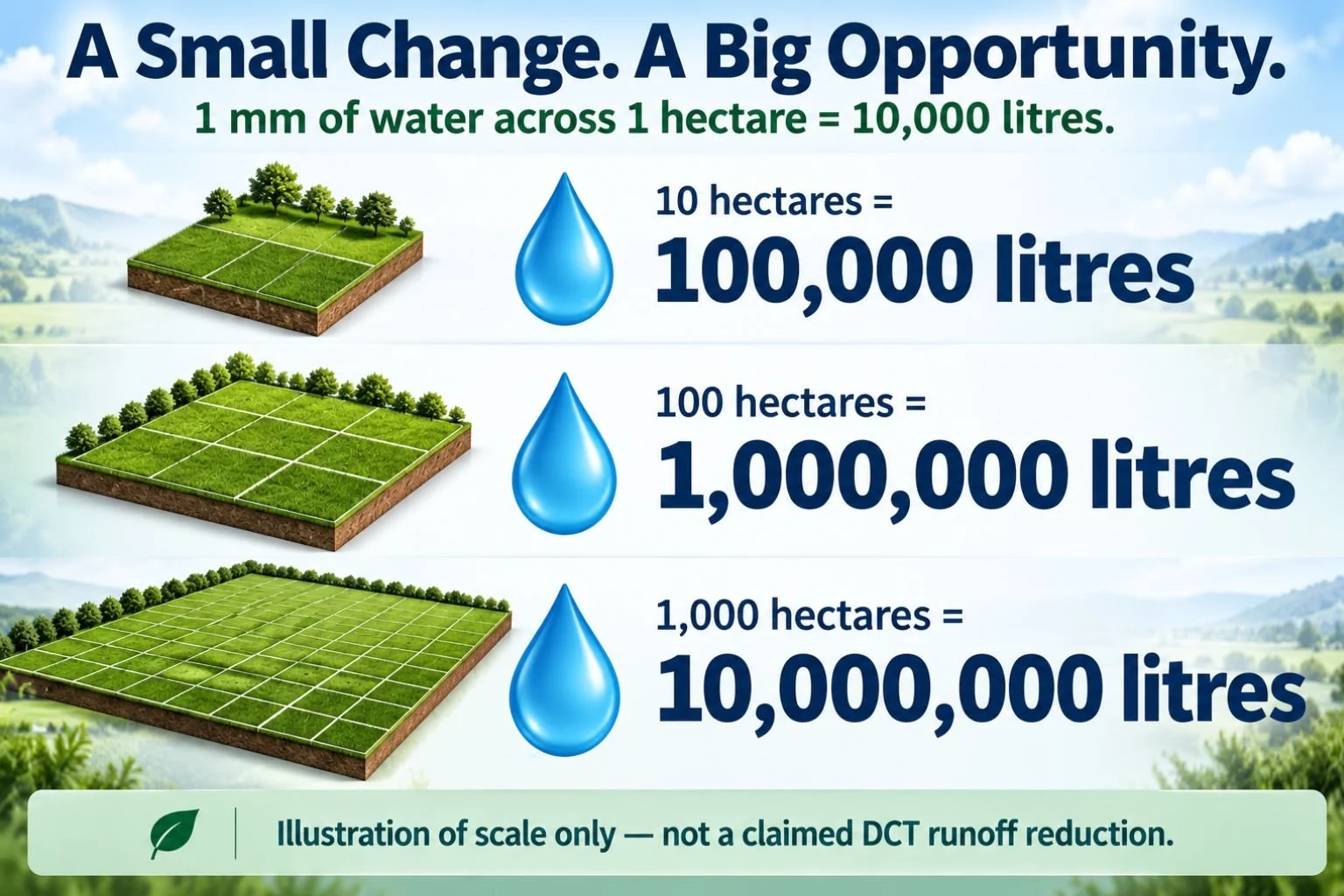
1 mm of water across 1 hectare = 10,000 litres.
DCT is not claiming a 1 mm runoff reduction.
That remains to be measured.
The calculation simply shows why establishing even a modest repeatable effect could become significant.
A small change on one hectare is a soil result.
A repeatable change across hundreds or thousands of hectares begins to become a landscape result.
Why This Approach Could Be Different
Many flood-resilience interventions require land to be excavated, reconstructed, converted or set aside.
Those interventions can be extremely valuable.
DCT is investigating a different possibility:
Could the functional performance of suitable existing managed soil be improved without fundamentally changing what that land is used for?
DCT technology is delivered as a liquid treatment.
If a meaningful hydraulic response is independently established, that creates the possibility of working with existing land-management and application systems rather than physically reconstructing every treated area.
That potential scalability is one of the reasons the hypothesis matters.
A paddock remains a paddock.
A park remains a park.
A sports ground remains a sports ground.
A road verge remains a road verge.
A commercial landscape remains a commercial landscape.
But what if the soil underneath could do more?
If that can be independently demonstrated, it creates the possibility of distributed resilience across areas where rebuilding the landscape as conventional stormwater infrastructure would be unrealistic.
This Does Not Replace Flood Infrastructure
Soil cannot absorb an unlimited storm.
Eventually storage can fill.
Soils can become saturated.
Some floods are driven by major river systems, coastal processes or circumstances where changing local soil behaviour may have little effect.
Pipes still matter.
Drains still matter.
Stopbanks, detention systems, wetlands and engineered flood protection still matter.
The opportunity is complementary:
Can better-functioning land reduce or delay some of the water those systems have to manage?
If the answer is yes, soil becomes another layer within the resilience system.
The Question Now Is Simple
The underlying science tells us that soil structure, pore architecture, roots and water movement are connected.
DCT programmes have already recorded measurable changes in some of those upstream characteristics.
What has not yet been established is whether those changes are large enough to produce a useful change in runoff volume or timing.
That is the question DCT believes is now worth investigating.
Flood resilience may begin before the drain.
It may begin with what happens between the raindrop and the soil beneath our feet.