
Soil Structure & Physical Properties — Science Explained
Executive Summary
Soil physical condition is a critical driver of agricultural productivity, influencing water movement, root development, and resilience to environmental stress.
A substantial body of research demonstrates that soil organic matter and carbon-based inputs — including humic substances (humic and fulvic acids) and seaweed-derived compounds — contribute to improvements in:
Aggregate stability
Bulk density
Water infiltration
Moisture retention
The mechanisms are well understood and directly relevant to New Zealand soils. While the magnitude of change is soil-specific and management-dependent, directional improvements are consistently observed.
Introduction
Soil health is not determined by chemistry alone. The physical arrangement of soil particles — and the movement of water and air through the soil — is critical to plant performance and system resilience.
Key soil physical properties include:
Aggregate stability
Bulk density
Water infiltration
Moisture retention
In New Zealand farming systems, soil structure may be constrained by:
Grazing pressure and compaction
Repeated cultivation
Low organic carbon inputs
Reduced biological activity
These constraints can result in:
Poor water infiltration
Surface sealing and runoff
Restricted root development
Increased drought sensitivity
Carbon-based biostimulants are increasingly used to support gradual improvements in soil structure and water dynamics.
Interpreting Research in a New Zealand Context
Most controlled research on humic substances, seaweed extracts, and organic amendments has been conducted internationally.
Mechanistic evidence: Shows how soil processes respond to organic carbon inputs
Directional evidence: Indicates the likely trends in soil behaviour, rather than precise outcomes
NZ field experience aligns with these directional trends, demonstrating improvements in friability, water retention, and root growth, even where controlled trials are limited.
1. Aggregate Stability — Foundation of Soil Structure
Mechanisms
Humic and fulvic substances form organo-mineral complexes (Piccolo, 2001)
Enable cation bridging (Stevenson, 1994)
Stimulate microbial production of binding agents (Six et al., 2004)
Seaweed-derived polymers act as natural binding and gel-like agents (Craigie, 2011)
Evidence
Organic matter consistently improves macroaggregate stability
Increased resistance to slaking and surface crusting
Practical Outcomes
Better soil tilth and structure
Reduced crusting
Greater resilience under rainfall
2. Bulk Density — Supporting Porosity
Mechanisms
Organic matter is less dense than mineral soil, reducing overall soil density
Aggregation and biological activity increase pore space
Evidence
Reductions in bulk density and modest increases in total porosity have been widely observed (Haynes & Naidu, 1998)
Practical Outcomes
Improved root penetration
Better aeration
Enhanced workability
Note: Products do not mechanically relieve severe compaction.
3. Water Infiltration — Managing Water Entry
Mechanisms
Improved aggregation supports macropore formation
Reduced surface sealing allows better rainfall entry
Evidence
Increases in infiltration reported in responsive soils
Neutral or reduced infiltration observed where high polymer rates restrict pore continuity (Blanco-Canqui, 2017; Lehmann & Kleber, 2015)
Key Insight
Response is soil-specific and rate-dependent
Practical Outcomes
Potential for better rainfall utilisation
Reduced surface runoff
4. Moisture Retention — Increasing Plant-Available Water
Mechanisms
Humic substances enhance water binding and field capacity
Seaweed alginates act as micro-hydrogels to retain water near roots (Craigie, 2011)
Evidence
Increased plant-available water in soils with higher organic carbon content (Hudson, 1994; Rawls et al., 2003)
Practical Outcomes
Reduced drought stress
More consistent plant growth
Improved water use efficiency
5. Integrated Soil System Effects
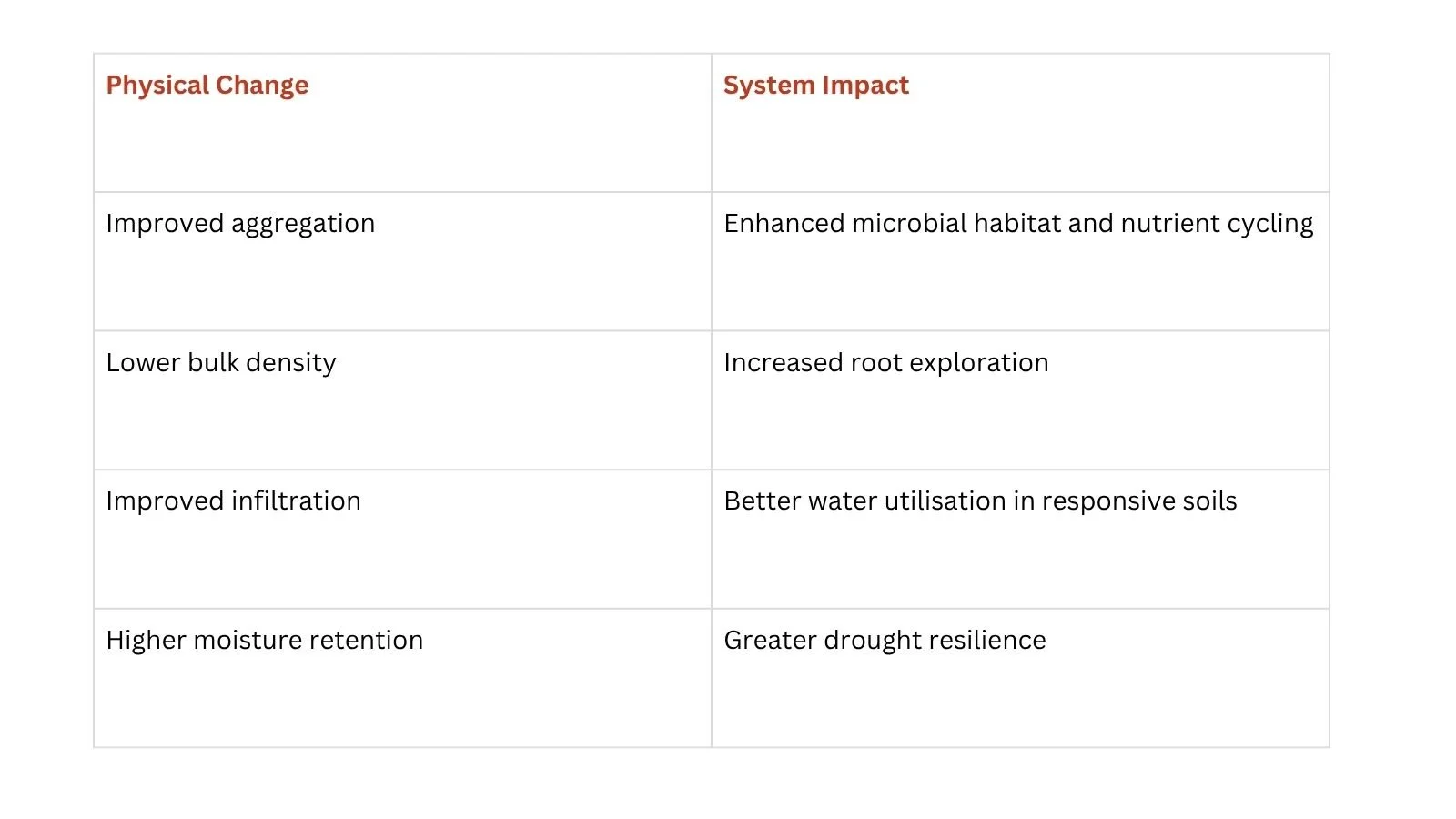
6. New Zealand Observations & Q&A Rebuttal
Observed Trends in NZ Systems
Improved soil friability and workability
Better water infiltration in some soils
Increased moisture retention in free-draining soils
Enhanced root development
Better crop performance during dry periods
Key NZ Objections & Evidence-Based Responses
Objection: “Overseas research doesn’t apply here.”
Response: Fundamental soil processes are universal. NZ soils show directional alignment with international research. Observational evidence validates trends, even if exact % changes differ.
Objection: “Humics won’t fix compaction.”
Response: True. Humics improve structure gradually via aggregation and biological activity. Severe compaction requires mechanical intervention.
Objection: “Water infiltration and retention are inconsistent.”
Response: Effects are soil- and rate-dependent. Moderate applications enhance infiltration and water retention without negative effects.
Objection: “No controlled NZ trials.”
Response: Observational NZ experience supports international mechanistic findings — trends in soil function are evident.
Objection: “Why humics vs general compost?”
Response: Humics and fulvics are functional fractions of organic matter, providing targeted biochemical benefits: organo-mineral binding, cation bridging, microbial stimulation. Seaweed polysaccharides enhance water retention.
Practical Talking Points for Growers:
Accelerates soil’s natural structure-building
Results are incremental, cumulative, and directional
Better root access, water supply, and resilience during dry periods
Best when combined with good management practices (grazing, tillage, cover crops)
7. Conclusion
Soil physical condition is critical for productivity and resilience.
Carbon-based inputs, including humic substances and seaweed-derived polymers, support improvements in:
Aggregation
Bulk density and porosity
Water infiltration and moisture retention
These improvements align with observed NZ trends, supporting more functional and resilient soils when integrated into a broader soil management strategy.

References
Blanco-Canqui, H. (2017). Soil structure and organic matter effects on infiltration. Soil Science Society of America Journal, 81, 687–698.
Calvo, P., Nelson, L., & Kloepper, J.W. (2014). Agricultural uses of plant biostimulants. Plant and Soil, 383, 3–41.
Craigie, J.S. (2011). Seaweed extract stimuli in plant science and agriculture. Journal of Applied Phycology, 23, 371–393.
Haynes, R.J., & Naidu, R. (1998). Influence of lime, fertilizer and manure applications on soil organic matter content and soil physical conditions. Nutrient Cycling in Agroecosystems, 51, 123–137.
Hudson, B.D. (1994). Soil organic matter and available water capacity. Journal of Soil and Water Conservation, 49, 189–194.
Lehmann, J., & Kleber, M. (2015). The contentious nature of soil organic matter. Nature, 528, 60–68.
Piccolo, A. (2001). The supramolecular structure of humic substances. Soil Science, 166, 810–832.
Rawls, W.J., Pachepsky, Y.A., Ritchie, J.C., Sobecki, T.M., & Bloodworth, H. (2003). Effect of soil organic carbon on soil water retention. Geoderma, 116, 61–76.
Six, J., Bossuyt, H., Degryze, S., & Denef, K. (2004). A history of research on the link between soil biota and soil aggregation. Soil & Tillage Research, 79, 7–31.
Stevenson, F.J. (1994). Humus Chemistry: Genesis, Composition, Reactions. Wiley.