What Independent Farm Testing Is Showing
Measurable field signals from operating New Zealand farms
Evidence at a Glance
1. Independent Nitrogen-Retention Research
More applied nitrogen retained under the study conditions
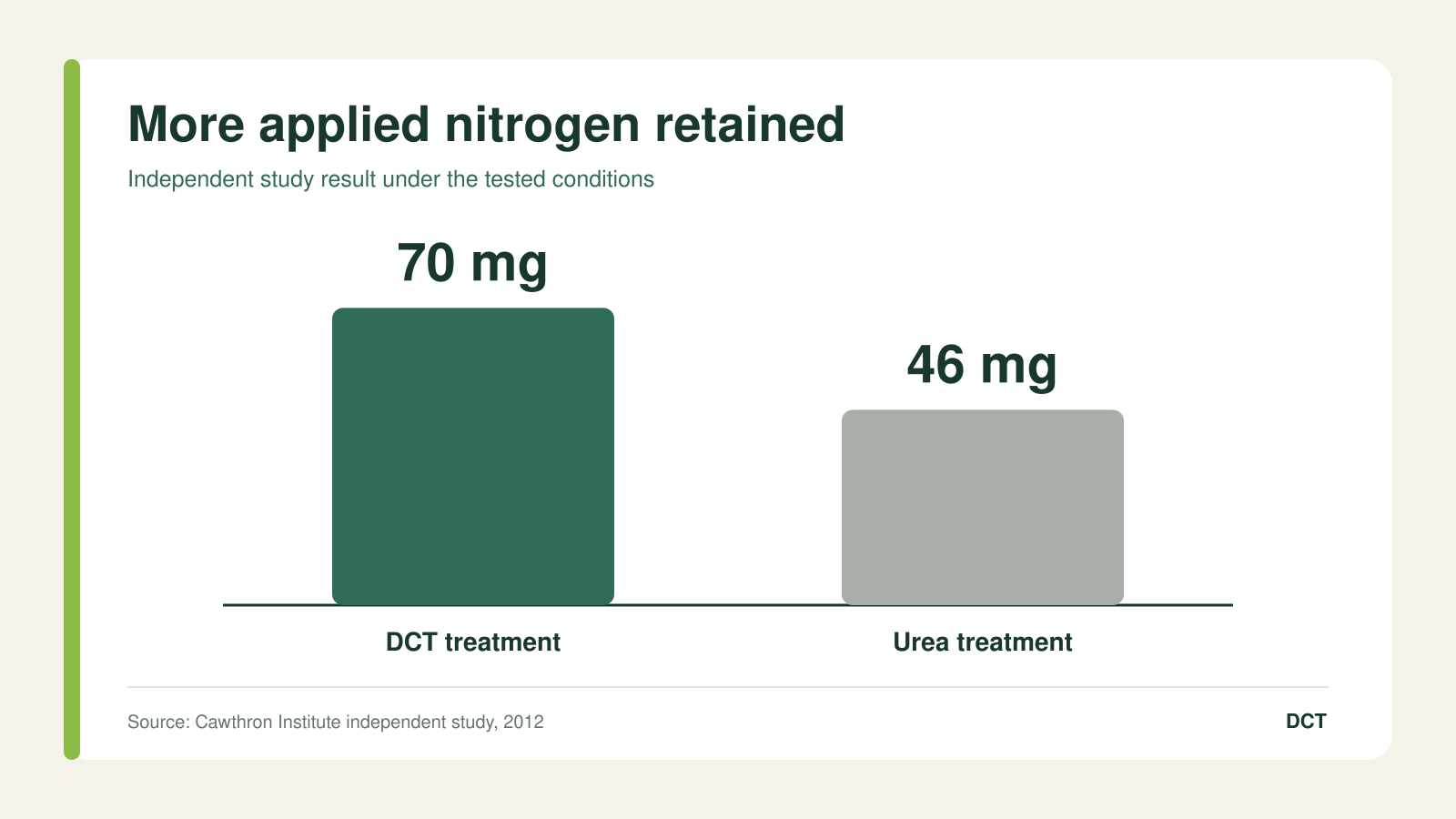
An independent Cawthron Institute study recorded:
70 mg of nitrogen retained with the DCT treatment
46 mg of nitrogen retained with the urea treatment
The difference of 24 mg represented an additional 12% of the nitrogen applied in the study being retained.
What it may mean
The result supports the potential for DCT technology to improve nitrogen retention and reduce the amount of applied nitrogen vulnerable to loss under comparable conditions.
What it does not prove
It does not establish a guaranteed reduction in nitrate leaching or fertiliser requirements across every soil, climate and farming system.
Evidence source: Cawthron Institute independent study, 2012.
2. A Recurring Soil Nitrogen Signal
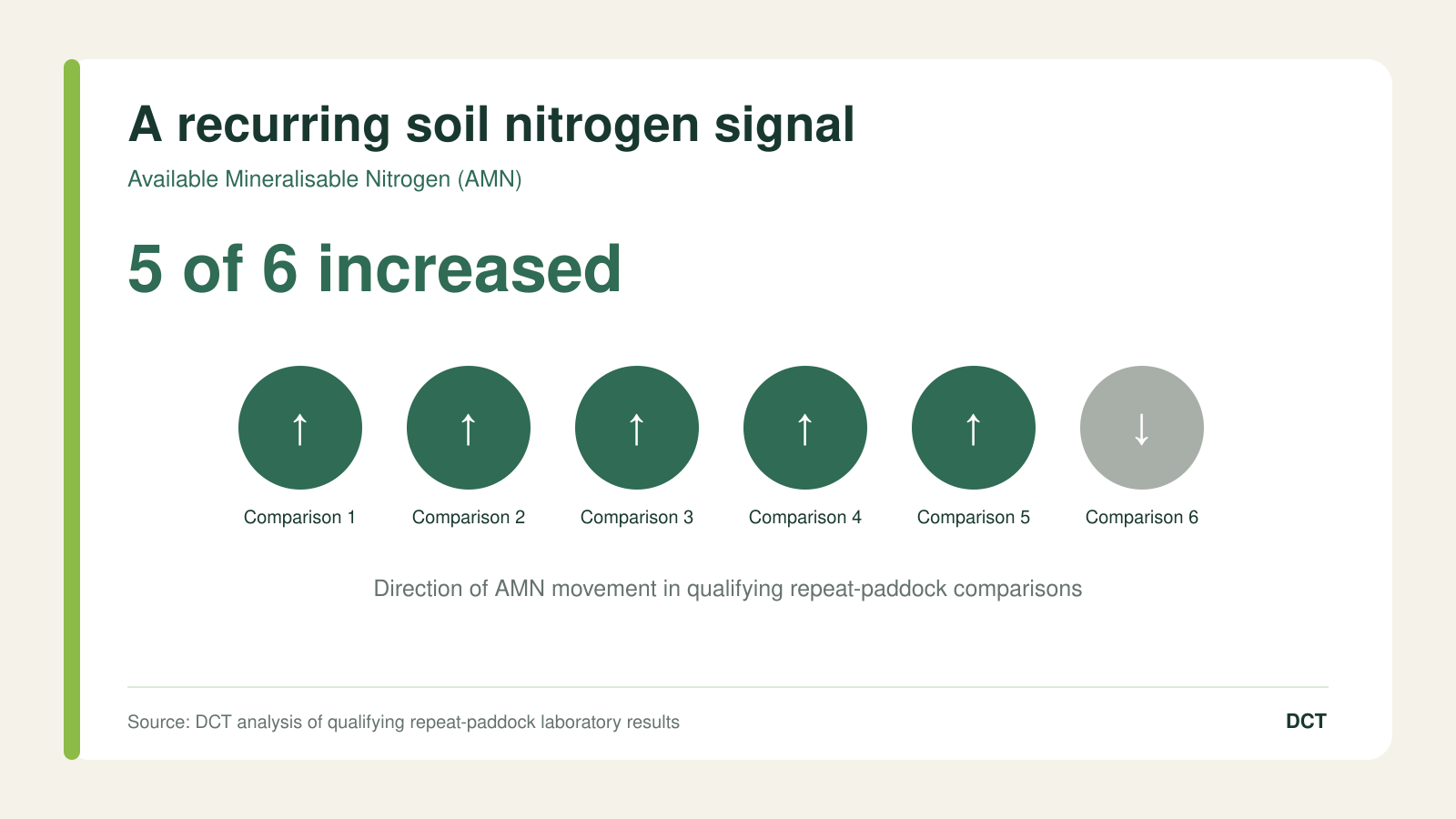
5 of 6 increased
Available Mineralisable Nitrogen, or AMN, increased in five of six qualifying repeat-paddock comparisons where the client, paddock identifier and recorded sampling depth matched.
AMN provides an indication of the soil’s potentially mineralisable organic-nitrogen reserve.
What it may mean
The recurring direction of movement is consistent with the development of a larger or more readily mineralised soil nitrogen reserve, potentially supporting greater biological nitrogen supply.
What it does not prove
AMN does not directly measure atmospheric nitrogen fixation, pasture production or a specific fertiliser saving.
Evidence source: DCT analysis of qualifying repeat-paddock laboratory results.
3. More Nitrogen Measured in Treated Herbage
22% higher nitrogen concentration
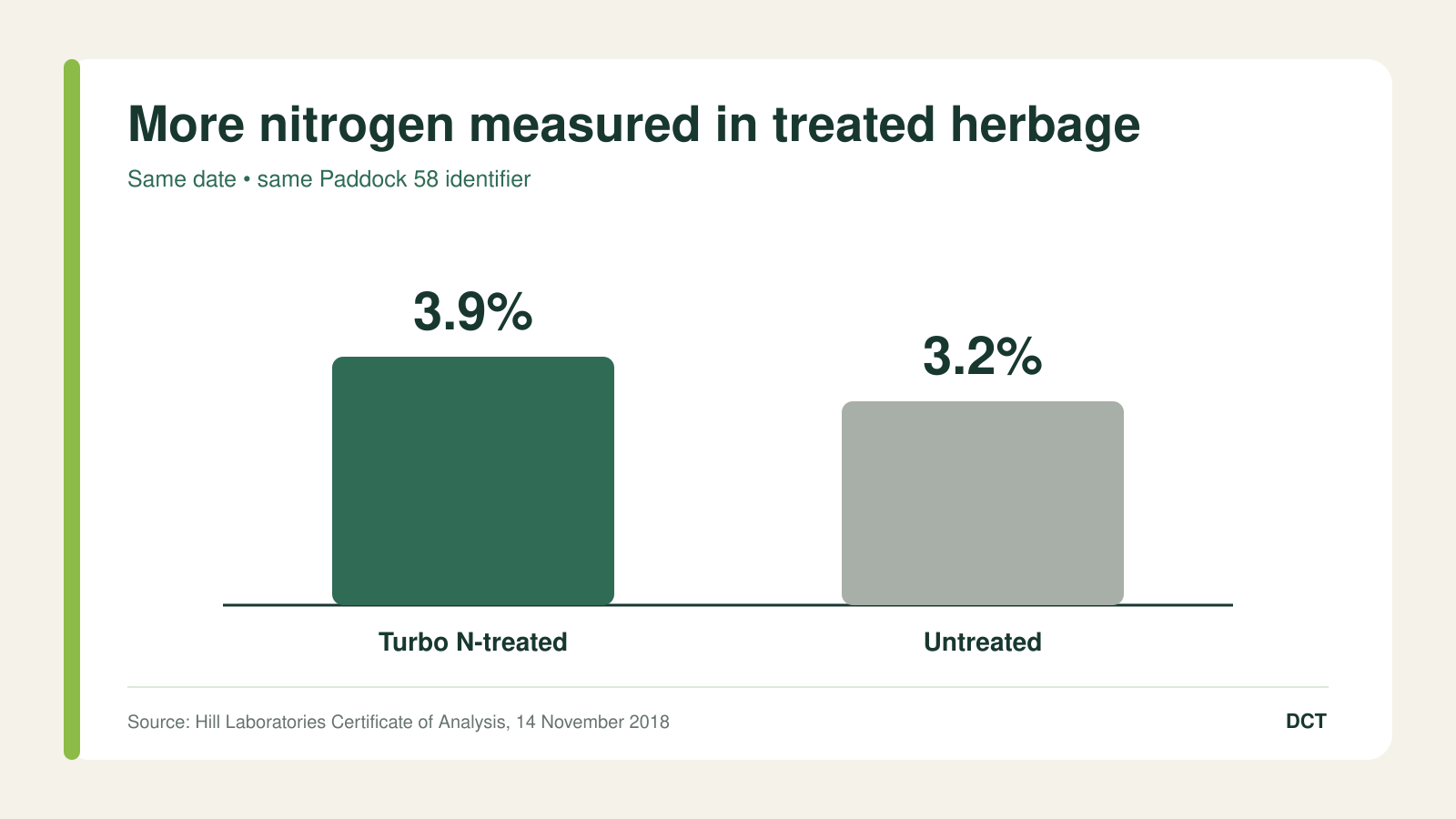
Turbo N-treated herbage contained 3.9% nitrogen compared with 3.2% in untreated herbage sampled on the same date under the same Paddock 58 identifier.
That represents a 22% higher nitrogen concentration in the treated herbage sample.
What it may mean
Improved nitrogen availability, plant uptake or plant nutritional status is plausible.
What it does not prove
Herbage concentration alone does not demonstrate additional pasture yield or total nitrogen uptake per hectare because dry-matter production was not measured in this comparison.
Evidence source: Hill Laboratories Certificate of Analysis, 14 November 2018.
4. Measured Root-Zone Development
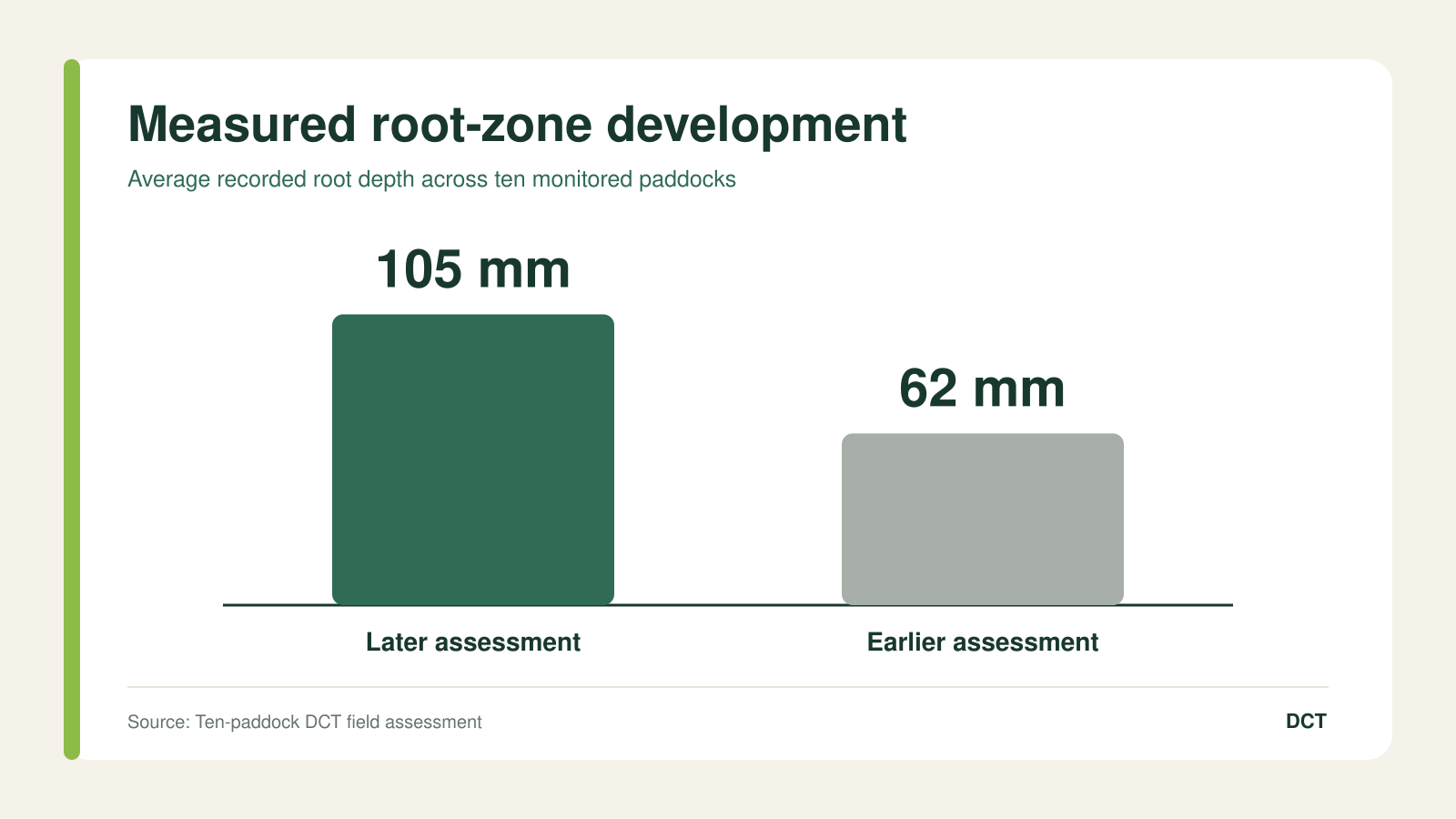
Average root depth increased from 62 mm to 105 mm
Across ten monitored paddocks, average recorded root depth increased by 43 mm—an increase of more than 51%.
What it may mean
Deeper rooting is consistent with improved access to water and nutrients and may contribute to greater pasture resilience during dry or variable conditions.
What it does not prove
This measurement does not quantify additional water storage, drought protection, pasture production or flood-risk reduction.
Evidence source: Ten-paddock DCT field assessment.
5. More Clover Recorded Across Ten Paddocks
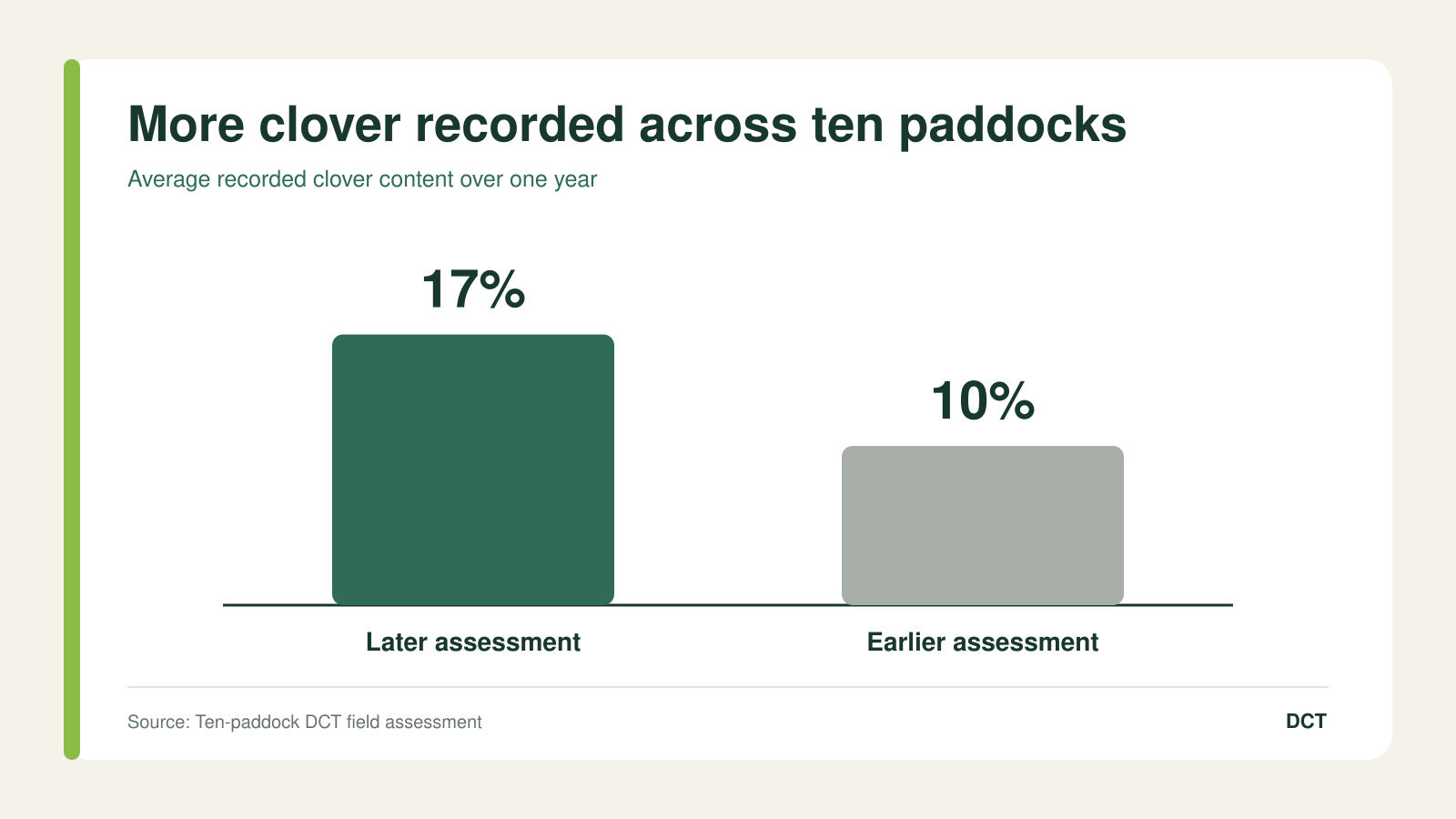
Average recorded clover content increased from 10% to 17%
Across ten monitored paddocks, average recorded clover content increased from approximately 10% to 17% over one year.
The recorded range moved from 5–15% initially to 8–25% at the later assessment.
What it may mean
A stronger clover component may support pasture quality, biological nitrogen fixation and reduced reliance on externally applied nitrogen.
What it does not prove
Clover percentage alone does not quantify the amount of nitrogen fixed or demonstrate a specific reduction in fertiliser requirements.
Evidence source: Ten-paddock DCT field assessment.
How the Comparisons Were Selected
The archive contains soil, herbage and supporting reports collected across different farms, years and testing programmes.
Repeat-paddock comparisons were only used where identifying information was sufficient to establish a reasonable match, including the client record, paddock identifier and recorded sampling depth where available.
Reports were excluded from repeat analysis where DCT could not confidently establish that the samples represented the same location or a sufficiently comparable sampling method. Both improving and declining results were retained within the qualifying comparisons.
Because historical product and management records are incomplete for some periods, associations with DCT programmes are clearly distinguished from results for which application information is available.
Not Every Measurement Improved
Not every paddock and not every measurement improved.
DCT retained declining and neutral results where the underlying comparison met the selection criteria. The purpose of the archive analysis is to identify recurring signals and useful questions—not to present normal commercial-farm variability as a perfect result.
What Progression Over Time Can Reveal
A single soil test provides a snapshot. Repeat testing becomes more valuable because it can show whether important measurements are moving, holding or declining over time.
The DCT archive includes repeat histories in which more than one soil property changed in the same paddock.
One Repeat-Paddock Example
In one qualifying repeat history:
Total carbon increased by 25%.
AMN increased by 18%.
Cation Exchange Capacity remained unchanged.
The unchanged Cation Exchange Capacity, or CEC, provides useful context. It shows that the AMN and carbon movements were not accompanied by a corresponding change in the soil’s measured exchange capacity.
This result is consistent with carbon-related soil development occurring alongside an increase in the potentially available organic-nitrogen reserve.
It does not establish that DCT caused the changes, nor does it demonstrate tonnes of carbon sequestered per hectare.
Evidence source: Qualifying repeat-paddock independent laboratory results.
A Possible Programme-Frequency Relationship
Commercial-farm records can also provide clues about how programme frequency may relate to the maintenance of soil measurements.
On one farm, DCT supply records showed two 24,000-litre Turbo N orders during the 2019–2020 season. During the following season, one 24,000-litre order was recorded.
A later order dated 6 December 2021 was for 30,000 litres of Turbo N at an intended application rate of 200 litres per hectare. This quantity was intended to provide one application over approximately 150 hectares.
Across four monitored paddocks, three subsequently recorded lower AMN, total carbon and organic-matter measurements, while one paddock improved.
What this pattern may indicate
The timing and direction of the results are consistent with the possibility that programme frequency may influence the maintenance of soil measurements.
It is also consistent with the practical expectation that soil and biological responses may depend on continued management rather than a single application producing a permanent change.
What remains uncertain
The records do not establish that every monitored paddock received precisely the same application history. They also cannot exclude the effects of:
Seasonal conditions.
Fertiliser history.
Grazing management.
Soil variability.
Sampling conditions.
Other changes within the farming system.
The pattern is therefore presented as a commercially relevant observation—not proof that fewer applications caused every reduction.
Evidence source: DCT product-supply records and repeat-paddock laboratory results.
Connecting the Measured Results
The archive did not measure every stage of one continuous biological process. However, the independent findings can be arranged into a scientifically plausible pathway:
Improved nitrogen retention
↓
Development of the soil’s potentially mineralisable nitrogen reserve
↓
Greater nitrogen availability to plants
↓
Stronger plant nitrogen status
↓
Potential to support productive pasture with less reliance on conventional nitrogen
The first four parts of this pathway are supported to varying degrees by independent research or laboratory measurement within the DCT evidence base.
The final outcome—how much conventional nitrogen an individual farm may be able to reduce while maintaining production—must be established through farm-specific records and monitoring.
One possible contributor to improved biological nitrogen supply is greater use of atmospheric nitrogen through nitrogen-fixing plants and microorganisms.
Atmospheric nitrogen fixation was not directly measured in these tests. It therefore remains a scientifically plausible pathway rather than a demonstrated archive result.
Interpreting the Carbon Results
Selected repeat histories recorded changes in total carbon and organic matter, including some unusually large individual movements.
These results are potentially important, but soil carbon measurements can be affected by:
Sampling location and depth.
Soil moisture and bulk density.
Recent organic inputs.
Soil type and spatial variability.
Previous land use.
Localised soil conditions.
Changes in laboratory methods.
For this reason, DCT does not use percentage changes in soil carbon concentration to claim a corresponding percentage increase in whole-farm carbon storage.
Demonstrating carbon sequestration requires consistent sampling protocols, bulk-density measurements and calculations across a defined soil depth and land area.
The archive therefore provides evidence of carbon-related soil change, not a quantified claim of tonnes of carbon sequestered.
What the Archive Can—and Cannot—Tell Us
These are independent laboratory results from operating commercial farms—not the results of one controlled, replicated experiment.
Commercial-farm data naturally includes variation in soils, seasons, grazing, fertiliser history, management and sampling.
DCT therefore distinguishes carefully between what was measured or recorded, what is consistent with the results and what has not yet been established.
Nitrogen Retention
Nitrogen Retention
Measured or recorded:
Nitrogen retention under the Cawthron study conditions.
Consistent with the result:
Improved nitrogen-use efficiency.
Not yet established:
A guaranteed farm-wide nitrogen saving.
Soil Nitrogen Cycling
Measured or recorded:
Changes in Available Mineralisable Nitrogen.
Consistent with the results:
Improved biological nitrogen cycling.
Not yet established:
The rate of atmospheric nitrogen fixation.
Plant Nitrogen Status
Measured or recorded:
Differences in herbage nitrogen concentration.
Consistent with the result:
Improved nitrogen availability or plant uptake.
Not yet established:
Additional pasture yield from this comparison.
Carbon-Related Soil Change
Measured or recorded:
Changes in total carbon and organic matter.
Consistent with the results:
Carbon-related soil development.
Not yet established:
Tonnes of carbon sequestered per hectare.
Root Development
Measured or recorded:
Increased recorded root depth.
Consistent with the result:
Improved plant access to water and nutrients.
Not yet established:
Quantified drought or flood protection.
Clover Development
Measured or recorded:
Increased recorded clover content.
Consistent with the result:
Greater potential biological contribution to pasture nitrogen.
Not yet established:
The quantity of nitrogen fixed.
Programme Frequency
Measured or recorded:
Changes associated with different programme and purchasing patterns.
Consistent with the results:
Programme frequency may affect the maintenance of soil measurements.
Not yet established:
That programme frequency directly caused the changes.
Conventional Nitrogen Use
Measured or recorded:
Reductions in conventional nitrogen use recorded on commercial farms.
Consistent with the records:
Reduced reliance on conventional nitrogen may be achievable within productive farming systems.
Not yet established:
The reduction achievable on every farm.
Evidence From a Broader Technology Platform
The highlighted commercial-farm results predominantly involve Turbo N because it was DCT’s principal dairy-farm programme during much of the testing period.
Turbo N is not an isolated technology. It is built on the same underlying DCT soil-and-plant technology platform used across the company’s product architecture.
The platform combines carbon-based soil-support compounds with plant-functional components and selected nutrients, adapted for different farming systems, application methods and nitrogen programmes.
Results obtained with Turbo N should not be interpreted as proof that every DCT product will produce an identical response.
They do, however, provide relevant evidence about the underlying technology principles shared across the DCT range.
Why This May Matter Environmentally
The measured changes have potential environmental relevance through improved nitrogen retention, more effective nutrient cycling, deeper rooting, increased clover content and the possibility of reducing reliance on conventional nitrogen.
These pathways are explored separately, with clear distinctions between measured results, scientific plausibility and outcomes that still require confirmation.
From Measured Change to Farm Value
Soil and plant improvements only create financial value when they contribute to lower input costs, maintained or improved production, or greater farming-system resilience.
DCT’s commercial-farm history includes examples of substantially reduced conventional nitrogen use alongside continued productive performance.
The possible sources of return and the farm records supporting them are explored through DCT’s return-on-investment framework.
Our Position
DCT is not presenting this archive as a substitute for replicated scientific trials.
It is being presented because independent testing from working farms has repeatedly detected changes relevant to:
Nitrogen retention.
Soil nitrogen cycling.
Plant nutritional status.
Root development.
Clover content.
Carbon-related soil properties.
The efficient use of farm inputs.
When these field signals are considered alongside controlled nitrogen-retention research and commercial-farm experience, they form a credible and commercially relevant body of evidence.
The responsible next step is not to assume that every outcome is proven. It is to use the evidence to support structured adoption, continued measurement and further independent validation.
Better Farming Starts With Better Understanding
DCT works with farmers and rural professionals interested in improving soil function, nutrient efficiency and farming-system performance.
An evidence schedule identifying the source, date, measurement type and evidence classification for each headline result is available from DCT, together with supporting reports where appropriate.